
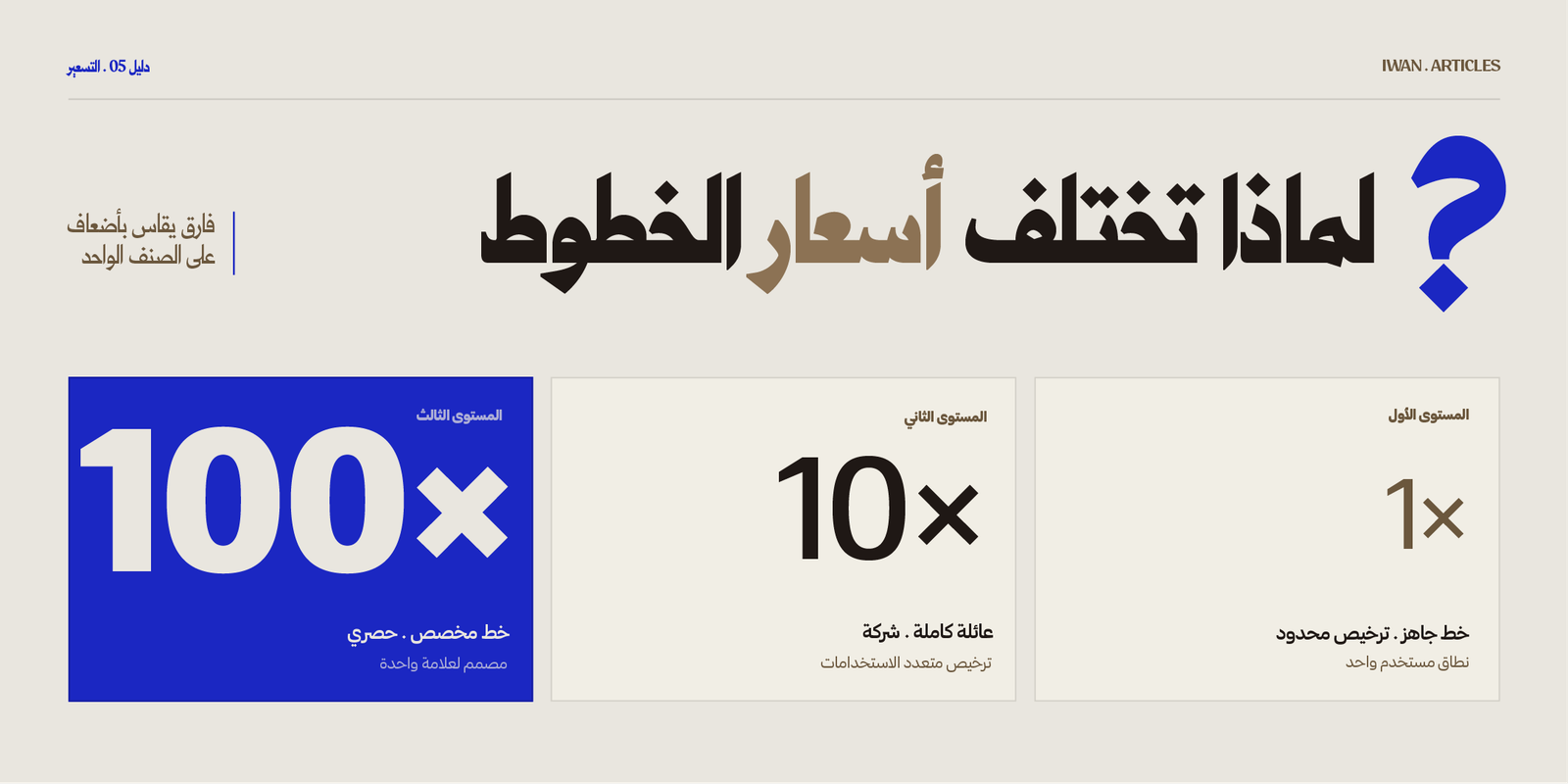

It is a fair question for anyone buying a font for the first time: a font is a digital file that a computer can copy at no cost. So why does one cost a few dozen dollars and another thousands?
The answer is that the price does not measure the file. It measures three entirely different things.
1️⃣ The first factor: the scope of use, not the file
This explains more of the gap than anything else, and it is the least obvious to a new buyer.
The very same typeface can sell for a low price to a freelance designer or a small team on a Desktop license, and for far more to a company that puts it on its website with no traffic cap and has an unlimited number of employees using it.
The file has not changed. What you are allowed to do with it has.
The logic is familiar from other fields: a photo licensed for a single post costs less than the same photo licensed for a global campaign. The difference is that a font looks like “just a file,” so its pricing seems mysterious.
Review the license types to see how the scope changes in practice.
2️⃣ The second factor: the size of the system inside the file
Two typefaces at the same price may differ several times over in the work that went into them.
Number of weights. Every additional weight expands the drawing, testing and review work. It is not a mechanical fattening of the weight before it: stroke thickness, white space and details are rebalanced, even when the weight is interpolated between masters. A family of seven weights is clearly more work than a family of three.
Number of glyphs. An Arabic font does not store just 28 letters. Each letter has up to four forms depending on its position, and then come the ligatures, alternates, numerals, punctuation and vowel marks. An Arabic font file usually contains hundreds of glyphs, most of which cannot be typed directly.
Diacritics (tashkeel). Handling vocalized text properly means positioning every mark over every letter, then adjusting how two marks stack together. That is a huge amount of work, and it only shows when you type vocalized text.
OpenType features. Stylistic alternates, discretionary ligatures and localized forms are each a piece of logic programmed into the file and then tested.
Languages. Supporting Urdu, Kurdish or Persian means additional glyphs and different behavior, not just a few extra characters.

3️⃣ The third factor: exclusivity
A commercial typeface is available to a large number of potential buyers, so in theory its design cost is spread across many sales. A custom typeface is designed for a single client, who bears the full cost.
And when it is exclusive, meaning the designer undertakes not to sell it to anyone else, they give up all future income from it. That concession is an inherent part of the price.
That is why a custom typeface falls into an entirely different price range from a retail one, and comparing the two directly means comparing two different things.
💡 What should you check before using a free font?
A low price does not mean poor quality. There are excellent free Arabic fonts, and some of them are funded by tech companies or cultural initiatives, so their cost was paid somewhere else.
But “free” is not a specification, so check these points yourself instead of assuming:
- Weights — how many are there really? Are they enough for the hierarchy your project needs?
- Diacritics — type a fully vocalized sentence and watch for colliding vowel marks
- Latin script — does it include one? If not, do you have a Latin typeface you plan to pair with it? (Pairing two typefaces is sound design practice, not a flaw in itself.)
- License — read the license file that comes with it. Does it cover commercial use? Does it include web and apps?
- Source — did you download it from the designer’s or foundry’s website, or from an aggregator site? If you cannot find a clear license or a reliable source, you are taking on a legal risk, not saving money
The same five points apply to a commercial font. The difference is that a commercial font usually answers them on its own page.
We go into this in more detail in our article on alternatives to free Arabic fonts.
⚖️ Most important: a higher price does not mean higher quality
This is something you rarely hear on websites that sell fonts.
A simple typeface, skillfully built for a specific purpose, may serve your project better than a huge family packed with features you will never use.
The right question is not “How much does it cost?” but “What am I paying for, and do I need it?”
A company that needs the font on its website will not be covered by a Desktop license, however tempting the price: it will need a Web or Unlimited license. And a freelance designer working on print has no reason to pay for scope they do not use. In both cases, the difference is scope, not quality.

🧮 How to compare fairly
Before you compare two prices, make sure you are comparing the same thing:
- Scope — do both licenses cover the same use?
- Weights — a single weight or a full family?
- Languages — Arabic only, or Arabic with Latin?
- Diacritics — do both typefaces handle them equally well? Test them with a vocalized sentence
- Payment — one-time, or a recurring subscription?
Once these five are lined up, the price difference makes sense, or one of the two options turns out to be clearly better.
Try any typeface with your own text on its page before you buy.
🔖 Browse the collection
- Buy with a commercial license — license types
- All typefaces — the full collection
- When does a company need a custom typeface?
❓ Frequently asked questions
Three factors: the permitted scope of use (the number of users, and whether it covers web and apps), the size of the system inside the file (weights, glyphs, diacritics and OpenType features), and exclusivity, since the designer of a custom typeface gives up any future income from it.
Not necessarily. A simple typeface, skillfully built for a specific purpose, may serve you better than a huge family with features you will never use. The question is what you are paying for, and whether you need it.
Because the price measures the scope of use, not the file. A Desktop license for a designer or a small team is not the same as an Unlimited license for a company that puts the font on its website with no cap on traffic or users, even though the file is the same.
Because a retail typeface spreads its design cost across many buyers, while a single client bears the full cost of a custom one. And if it is exclusive, the designer gives up all future income from it, which is part of the price.
An Arabic letter has up to four forms depending on its position, every diacritic has to be positioned over every letter, and then the stacking of marks has to be adjusted. And every additional weight expands the drawing, testing and review work. It is not just a mechanical increase in stroke thickness.
2 thoughts on “Why do some fonts cost thousands of dollars while others sell for a few dozen?”
Comments are closed.