
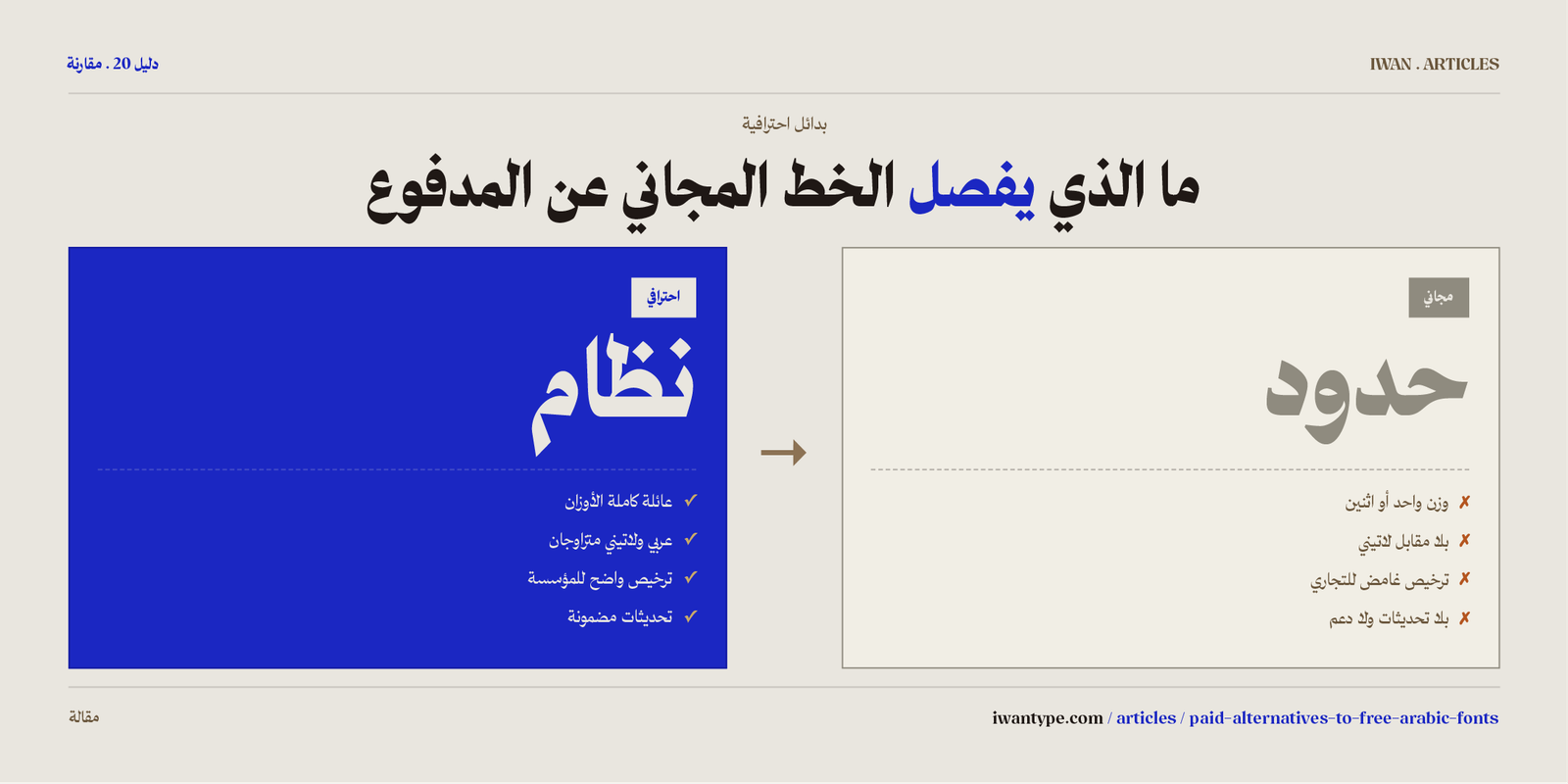

A free font is not necessarily a bad one. Some of the best Arabic typefaces available for free are well designed and do their job in many projects.
The problem shows up somewhere else: when the typeface becomes part of a brand identity, when the project needs typographic details that the free font does not offer, or when the legal department asks about the license.
This article explains when that moment comes, and what the practical alternative is in each case.
⚖️ Three practical differences
Distinctiveness
The number of weights is no longer the deciding difference it once was. Some modern free families really do come in multiple weights: IBM Plex Sans Arabic, for example, has seven weights in Arabic and Latin, and it performs well in interfaces and neutral, functional settings.
The real difference lies elsewhere. An open-source font (and any widely distributed free font, for that matter) is available to a very large number of users, so when you build your brand on it, you share your voice with everyone who downloaded the same file. In fact, the best of the free typefaces was originally designed as another organization’s identity: Plex is IBM’s official voice first, and a public typeface second.
And the first thing an identity typeface must do is set its owner apart. That is where a commercial font proves its value: narrower distribution and a personality drawn for a purpose. Wathiq has seven weights designed as one system for headlines and text, while Shaheen Pro, Huwiya and Qomra come in five weights each.
Typographic details
Alternates, ligatures, swash letters and alternate dots: these are what make a line of Arabic look typeset rather than pieced together.
Qomra and Asal include these features. That depth is not exclusive to commercial fonts: the open-source Amiri is one of the richest Arabic typefaces in OpenType features, because someone stood behind it and put in those months of work. So the practical question is not “How much does the font cost?” It is: who is responsible for the file after its release, for its Arabic ligatures, for fixing its bugs and for updating it when systems change?
Licensing
Commercially, this is the most important difference.
The accurate division is not “free and paid,” since every legal font is a licensed font. It is three categories:
- Open source with a clear license (such as the SIL Open Font License, OFL): a public document allows commercial use, and support rests with the publisher or the project’s community.
- Commercial, with a clear license: a document that sets out what is and is not allowed, and a known party you can turn to, with a level of support and updates that depends on the foundry’s policy and the license terms.
- Of unknown origin, or restricted to personal use: fonts from download sites, where no one knows by what right they are distributed; some were uploaded without their designer’s permission in the first place.
Only the third category is a real legal risk, and a company that builds its identity on a font from it usually finds out at the worst possible time: when it expands, or during a legal review.

✅ When free really is enough
To be fair, a free font is a reasonable choice for:
- A student or training project
- An internal publication that does not represent the brand
- A quick prototype before the direction is approved
- Temporary content that will not be repeated
- A neutral, functional interface that is not expected to represent the brand
What these cases share is that the typeface is a passing tool, not one of the project’s assets. And a clearly licensed open-source font goes beyond this list anyway: legally, it works even for permanent assets, and the question that remains there is not legality but distinctiveness.
⚠️ When free becomes expensive
When the typeface is an asset you build on, the cost of a shared voice (or of an unclear license) ends up higher than the price of any font:
- A brand identity that will be used for years and appear in dozens of contexts
- A commercial product that is sold or licensed
- An app or website that needs the font files embedded
- A client project, where you are legally responsible to the client
- Any context where the typeface is meant to set you apart, not to be a shared voice available to everyone

🧭 How to decide in practice
Ask three questions:
If yes, the typeface is an investment, not an expense.
If yes, it represents you.
If you are not sure, you are looking at a risk, not a saving.
Three yeses mean you are dealing with an asset, not an expense, and your real choice is between two options: open source with a clear license, or a commercial font that usually gives you narrower distribution, more distinctive options and a known party you can turn to. Replacing an identity typeface later can end up costing more than investing in the right choice from the start, especially as your materials and channels multiply.
Try any typeface with your own text on its page before you buy, and review the license types to find the right one for your project.

🔖 Browse the collection
- All typefaces — the full collection
- Arabic fonts
- Naskh fonts — commercial Naskh alternatives
❓ Frequently asked questions
That depends on its license, not its price. An open-source font with a clear license, such as the OFL, can be used commercially without a problem. The risk lies in fonts of unknown origin: many fonts on download sites are for personal use only or were uploaded without their designer’s permission. Check the license file that comes with the font, and if you cannot find one, assume you are not licensed.
There are three practical differences: distinctiveness (a typeface available to everyone cannot set one brand apart), the depth of typographic detail (alternates and ligatures) and a clear license, with someone responsible for the file and its updates.
For functional interfaces, student projects, prototypes and temporary content. In fact, a clearly licensed open-source font is legally fine even for permanent projects. The deciding question then is distinctiveness: are you building your identity on a voice available to everyone?
It varies with the typeface, the number of weights and the license type. Check each font page for the options available: single-weight prices differ from those of the full family.
One thought on “Alternatives to free Arabic fonts: when open source is enough and when you need a commercial font”
Comments are closed.