
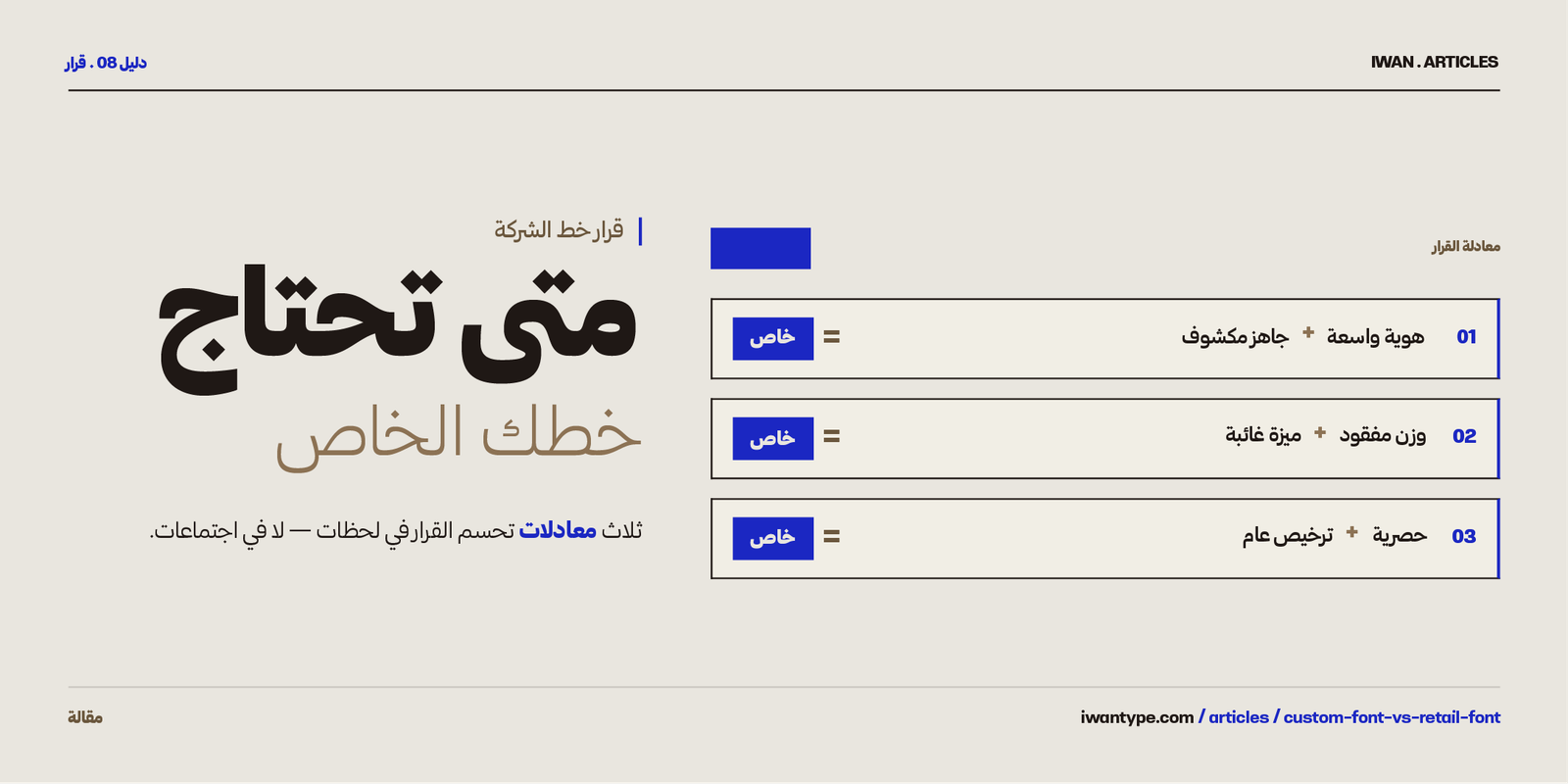

Most companies do not need a custom typeface. That is the most honest answer, and at Iwan Type we offer both: a licensed retail collection and custom typeface projects.
A licensed retail typeface covers what most companies need: a coherent identity, enough weights, a clear license and a known cost. A custom typeface starts to make sense when a need comes up that no retail typeface can meet, not when a company simply wants something “of its own.”
This article explains where that line falls.
🎯 Four questions that settle the decision
1. Does the brand have a voice the market does not offer?
Look at three competing brands. If you could swap their typefaces without anyone noticing, the problem is not the typeface but the positioning, and a custom typeface will not fix it.
But if your brand has a clear, distinctive position, and after a serious search (not half an hour of browsing) you still have not found a typeface that expresses it, that is the first real sign.
2. Does your brand speak in more than one language or script?
A company that works in Arabic, English and perhaps a third language needs harmony between scripts that are built very differently. Some retail typefaces cover Arabic and Latin together, but the need for a third script, or for fine control over how the scripts relate, may go beyond what is available.
3. Is the typeface part of the product itself, rather than its marketing?
The difference is fundamental. Type in an ad is seen once. Type in an app interface is used every day for years, and the same goes for type on a dashboard, on a device or on packaging read under store lighting.
Once the typeface becomes part of the product experience, its requirements multiply: precisely defined weights, well-defined behavior at small sizes and perhaps glyphs particular to your field. This is where retail typefaces start to falter.
4. Does the company repeat itself often enough?
A custom typeface can pay for itself through repetition. A brand that produces hundreds of pieces a year across several markets and departments will build up value. A brand that puts out one or two campaigns will not notice the difference.
A rough rule of thumb from Iwan Type (a practical judgment, not an industry standard): if you answer yes to three of the four, the conversation is worth starting. Fewer than that? Buy a retail typeface and spend the difference on better execution.
⚠️ When a custom typeface is a waste
When the identity itself is not settled. A custom typeface locks in a direction. If that direction has not been decided, you will pay twice.
When no one is guarding how it is applied. A custom typeface with no usage guide and no one to review its use will end up misused within months, or replaced with a system font in the first presentation an outside supplier puts together.
When the motive is “our competitor has a custom typeface.” That is a reason to revisit your positioning, not to start a typeface project.
When what you really need is a logo. Much of what companies think of as a custom typeface is actually custom lettering for the logo: a few carefully drawn letters, not a complete system. These are two entirely different projects, in both scale and purpose.

🧭 The middle ground many people overlook
Between “buy off the shelf” and “design from scratch” there are middle options that work for most cases:
- An extended license for a retail typeface, which gives the company wider scope without the cost of a full project
- Modifying or extending an existing typeface by agreement with its owner: adjusting specific letters or adding glyphs your field needs. Note that modifying a licensed font file without its owner’s permission is prohibited by most licenses, including ours, so this route starts with a conversation with the foundry, not with opening the file.
- Custom lettering for the logo, with a retail typeface for the rest of the system
- Choosing a broad family that covers headlines, text and interface, so that no customization is needed
The last option is the cheapest and the fastest, and it is often enough. Browse the full collection before you assume that what you need does not exist.
✅ If you decide to go ahead with a custom typeface
Prepare three things before you talk to any type designer:
Define exactly where the typeface will be used. Put it in a written list: print, website, app, signage, packaging. This list shapes the project more than anything else.
Collect examples of what you reject, not only what you like. “We don’t want to look formal” is clearer than “We want something elegant.”
Decide who decides. Typeface projects often stall not because of disagreements over the design, but because it is not clear who gives final approval.
To talk about a custom typeface project, start with our custom fonts page.
🔖 Browse the collection
- Buy with a commercial license — license types
- All typefaces — the full collection
- Arabic and Latin fonts

❓ Frequently asked questions
When its brand has a voice the market does not offer, it works in more than one script, the typeface is part of the product and not just its marketing, and it produces enough material for the value to build up. If fewer than three of these four apply, a licensed retail typeface is the better fit.
Custom lettering means drawing a few letters for the logo alone. A custom typeface is a complete system: every letter, numeral, punctuation mark and vowel mark, and how each one behaves in every context. Many companies need the first and ask for the second.
No. A typeface’s quality is measured by how it is built, not by how exclusive it is. A well-built retail typeface outperforms a rushed custom one, and many of the world’s strongest identities are built on commercial typefaces.
An extended license for a retail typeface, an agreement with the foundry to modify or extend an existing typeface, custom lettering for the logo with a retail typeface for the rest of the system, or simply choosing a broad family that covers all your uses.
Often it is not the design, but the lack of a clear approver, an identity that was not settled before the work began, or a typeface launched without a usage guide to keep its application on track.
One thought on “When does a company need a custom typeface instead of buying a retail one?”
Comments are closed.